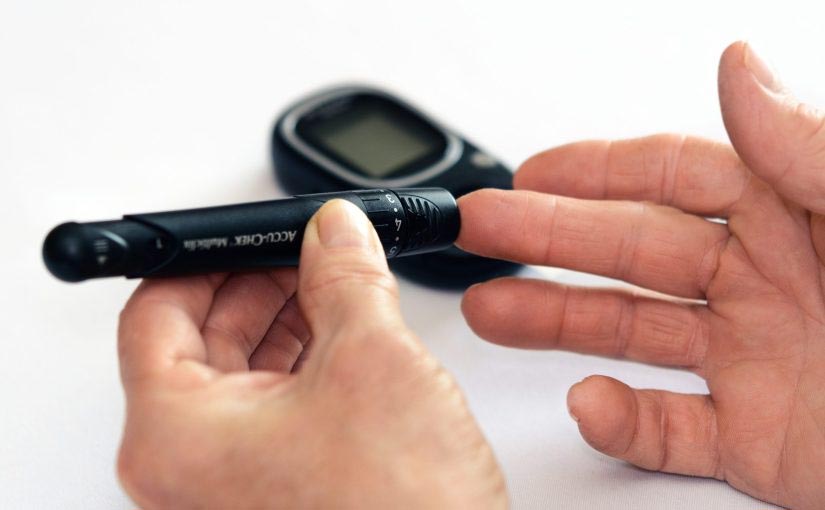
Mastering use of your glucose meter is perhaps the one most important habit you can establish! When I was first prescribed a meter, my doctor ordered enough test strips for me to test three times a day. Typically, this included fasting blood glucose, which is the first thing you do after you wake up and do nothing else except go to the bathroom and wash your hands. Once I got on insulin, it was also important for me to check my blood glucose just before bedtime. I used the third test strip at a random time during the day, pre-meal or post-meal.
If you do not have health care insurance coverage, or if you want more testing supplies than allowed by your healthcare coverage, you may find it convenient to have a cost-effective meter just for “eating to your meter ” testing. You do not need a prescription to purchase a blood glucose meter. Some of our group members have found the ReliOn (brand) meter and test strips to be suitable, and they are available at Walmart or on Amazon. Check current pricing and availability online.
Blood Glucose Meters (Glucometers)
If you have a blood glucose meter but have not been in the habit of using it, it may take a little time to get used to it again, especially if you haven’t used your meter for a long time. If it’s been over two years, you probably should get a new meter. You should replace your meter every 2-5 years.
Test Strips
Test strips are proprietary to every meter, though some meter manufacturers may use the same test strips for more than one of the meters they make. Test strips are not interchangeable between different brands of meters.
Make sure your test strips have not expired! Expired test strips will give inaccurate results. The manufacturer prints an expiration date on every vial of test strips. Always keep the test strips in their original vial. When you are handling a test strip to put it into your meter, be careful to not touch the part of the strip that receives the blood drop.
Lancets and Lancing Devices
Most meter manufacturers also make their own brand of lancing device and lancets. But you do not have to use the same brand of lancing system as your meter’s brand.
Manufacturers recommend you use a new lancet for every test. Those of us who have been doing this awhile use a lancet for several tests or until they get dull (because a dull lancet will hurt more than a new, sharp lancet). Rachel Head, a Certified Diabetes Educator, says, “In the grand scheme of things, a fresh lancet is not as critical to your health and well-being as the many other self-care tasks on your plate, like taking medications and counting carbs. If reusing a lancet makes it any more likely you’ll check your blood sugar, it’s fine to let it linger a little longer.”
Adjust your lancing device so that the lancet will go deep enough to get the required size of a blood sample, but not deep enough to bruise or be painful. You may need to squeeze gently to get enough blood, but do not squeeze too hard!
Lancets come in several gauges, from 19 gauge (the thickest) to 38 gauge (the thinnest). The thinner ones hurt less but get dull faster than a thicker gauge and you will need to replace them more often, so you just have to experiment until you get just the right setting for you. Most lancing devices come with 30 gauge lancets, but I prefer 33 gauge lancets.
If you have sensitive fingers or just “needlephobia,” there is a lancing system called Genteel, which a doctor developed especially for children’s delicate fingers and purports to be painless. At the time of this writing, you can find it at https://www.mygenteel.com/. You can also order on Amazon. https://www.amazon.com/Genteel-Vacuum-Lancing-Diabetes-Testing/dp/B013PT28XO/?th=1
The next best lancing system is the OneTouch® Delica® and Delica® Plus Lancing System. Lancets are available in two sizes for the OneTouch® Delica® lancing devices: 30 Gauge Fine and 33 Gauge Extra Fine. Check your local pharmacy and online sources for pricing and availability. The OneTouch® Delica® website includes an excellent 4-minute instructional video. https://www.onetouch.com/products/accessories/onetouch-delica-plus-lancing-device
How to Test
You have ten fingers and two sides on each finger, giving you a possible 20 sites to stick your fingers for a blood sample. We recommend you use the sides of your fingers, rather than the tips or the pads because there are fewer nerve endings in the sides of your fingers (and thus less pain). Rotate through your 20 test sites.
You should wash your hands before every test! This is to make sure you don’t have something on your hands (like food or anything else) that could interfere with the test. To assure accuracy in testing, always wash your hands with warm, soapy water (preferably with unscented soap), massaging the fingers, and dry your hands thoroughly. If your skin is not dry, the blood sample might become diluted with moisture. Failure to take the simple action of washing your hands with water before pricking your finger could cause falsely elevated readings. Do not use alcohol or hand sanitizer (which contains alcohol) on your fingers before testing! Alcohol will give you a false low.
If you have dry skin and need to moisturize your hands, please do so; but wash your hands before testing and re-apply your hand cream or lotion after you have tested.
It is unnecessary (and not recommended) to use alcohol at home, even though your doctor or nurse may do so in their medical facility. If/when you use alcohol, dry the finger thoroughly with clean gauze before testing. Do not use hand sanitizer (because it contains alcohol); in fact, if you have just used hand sanitizer, be sure to wash it off with warm, soapy water before testing. Use of soap and warm water has the potential to remove—not merely dilute—any potential interference from the skin surface and may provide the additional benefit of increasing localized skin site perfusion (the passage of fluid through the circulatory system).
Caveat: If it is totally impossible to wash your hands properly and all you have is alcohol swabs or hand sanitizer (which is 60%+ alcohol), use it; but make sure your hands are completely dry before performing a finger stick. If you have planned ahead and have clean gauze, use it to dry your testing finger(s).
It is unnecessary to discard the first drop of blood and use the second drop for testing. We recommend washing the hands with soap and water, drying them, and using the first drop of blood for self-monitoring of blood glucose. After washing and drying your hands, massage the fingers together; then massage more on the one finger you’re going to use, especially if your fingers are still cold. After lancing your finger, it’s okay to squeeze it a little to start the blood flowing. Even if a bit of interstitial fluid comes out, it contains about the same amount of glucose as the blood. CGMs (see “Continuous Glucose Monitors” below) measure glucose in the interstitial fluid.
Fasting (and pre-meal) blood glucose should be in the range of 70-99 mg/dL (3.8-5.6 mmol/l), and 1 hour after the first bite of your meal should be less than 140 mg/dL, or 120 mg/dL for good control. At 2 hours after the first bite of a meal, blood glucose should have come back down to close to the pre-meal number.
CGM (Continuous Glucose Monitors)
Continuous Glucose Monitoring (CGM) systems track glucose levels throughout the day. CGM users insert a tiny sensor wire just under their skin using an automatic applicator. An adhesive patch holds the CGM sensor housing in place so the sensor can measure glucose readings in interstitial fluid throughout the day and night. A small, reusable transmitter connects to the sensor wire and sends real-time readings wirelessly to a receiver, so the user can view the information. With some systems, a compatible smart device with the CGM system app can serve as the display device.
One popular brand is the FreeStyle Libre, with a sensor you attach to your arm. The sensor pairs with an app on your phone by which you can see the readings. You still have to use your regular glucose meter to check the accuracy of the CGM numbers. One 14-day application costs between $40 and $99, depending on insurance eligibility.
Finger-Based Non-Invasive Monitors (Contact Only)
These devices are designed to measure glucose by placing a finger on a sensor rather than pricking it. Note that many are still in development or have limited regional availability. Like CGMs, it is recommended to check accuracy with a traditional finger-stick glucometer.
If you got this email from someone who forwarded it to you, please consider subscribing to our blog yourself at https://adventistvegetariandiabetics.com/blog-posts/. Scroll down to the SUBSCRIBE box and enter your email address. Please be assured we will never share your email address with anyone else.
Adventist Vegetarian Diabetics™ Recipe Book was published in April 2023. It can be found on Amazon at ( https://www.amazon.com/Adventist-Vegetarian-DiabeticsTM-Recipe-Book/dp/B0C1JJTGLW/) in both Kindle and paperback formats.
Our classic book, Adventist Vegetarian Diabetics, 2nd Edition, was published in May 2023. It can be found on Amazon at ( https://www.amazon.com/dp/B0C5KNKS8B) in both Kindle and paperback formats. This book is now available as an audiobook, using an A.I.-generated voice. Check it out at https://www.amazon.com/ITEM_NAME/dp/B0D11Z3382/ref=tmm_aud_swatch_0.
We encourage you to join our Facebook group for Adventist Vegetarian Diabetics™ in order to ask questions, make comments, and share your own experiences. If you are not a member of the Facebook group for Adventist Vegetarian Diabetics but would like to be, please click the link and request to join. You will be asked 3 questions. Here’s a description of the Facebook group.
If you just want continuing information and don’t want to take part in any discussion, we recommend you peruse our website at https://adventistvegetariandiabetics.com/. We also have a Facebook information page, Adventist Vegetarian Diabetics Resources.
Please subscribe to our YouTube channel at https://www.youtube.com/@adventistvegetariandiabetics.
 Adventist Vegetarian Diabetics